Guides · Resins and materials
Best water-washable resin: choose by SDS and end use
Water-washable resin can simplify the cleaning liquid, but it remains uncured photopolymer. Compare safety data, mechanical intent, colour and maker profiles before buying.
This page contains Amazon affiliate links. As an Amazon Associate we earn from qualifying purchases. Prices and availability can change; check the exact listing before buying.
We haven't tested these products. This comparison is based on makers' published specifications and manuals, retailer listings and owner reviews (checked 15 November 2026).
The best water-washable resin is the one with a current safety data sheet, a maintained profile for your printer and mechanical properties that suit the object. Water clean-up is a workflow characteristic. It does not mean the liquid is harmless, biodegradable, suitable for skin contact or safe to pour into a drain.
This guide does not rank bottles by owner star ratings or repeat unverified strength claims. Resin formulas can change without the product family name changing. Read the label and SDS for the exact bottle and colour you receive, then retain a copy with the batch record.
Start with the hazard document
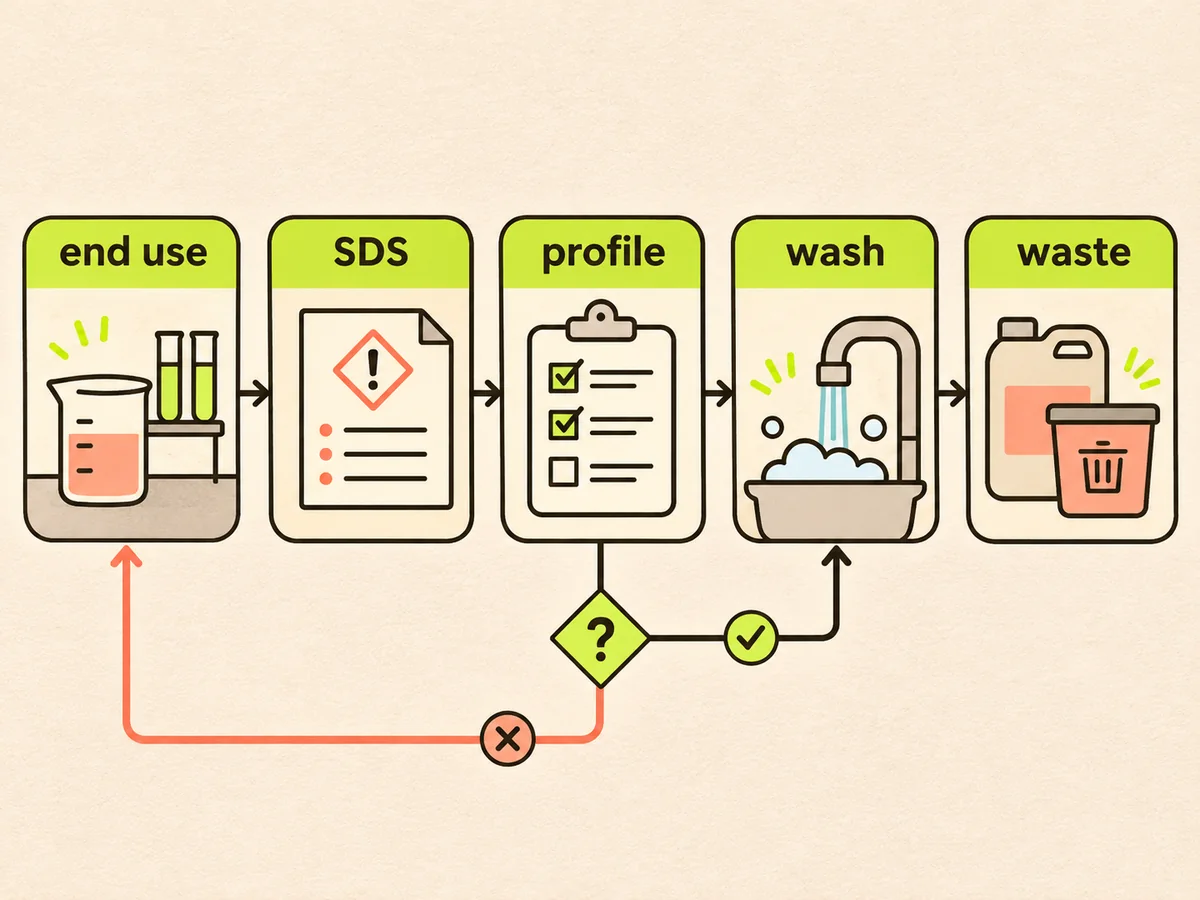
Elegoo's water-washable photopolymer resin SDS, revised 8 January 2024, identifies the product for 3D printing and lists hazard statements including H315 for skin irritation, H317 for an allergic skin reaction and H318 for serious eye damage. It also says to ensure good ventilation or extraction and prevent aerosols. Those statements are enough to reject the common idea that water-washable resin can be handled like poster paint.
The SDS lists individual protection measures and disposal information. Your exact product may differ, so the point is not to treat Elegoo's sheet as a generic sheet for every brand. HSE says the supplier should provide a data sheet for a substance dangerous for supply and that the SDS gives information about properties, health effects, exposure routes and risk-reduction measures. Ask the seller before purchase if the document is missing.
What “water-washable” changes
It can remove the need to use IPA as the primary wash liquid where the maker instructs water cleaning. This avoids bringing a large volume of a highly flammable solvent into that stage. It does not eliminate chemical exposure, contaminated liquid storage, post-curing, gloves, eye protection or ventilation.
The wash water accumulates uncured resin and fine particles. Keep it in a closed, labelled container. Never use a kitchen or bathroom sink as the wash station. Formlabs' general resin disposal guidance says liquid and partly cured resin, and contaminated solvent, should not enter drains or household waste; follow the exact resin instructions and your council's route.
Water also dries differently from IPA. Hollow parts and deep recesses can retain it. A part should be dry inside and out before UV post-cure, because trapped liquid can interfere with the surface or remain sealed inside. Provide drain and vent holes that work in the print orientation and the wash orientation.
Choose the family by the job
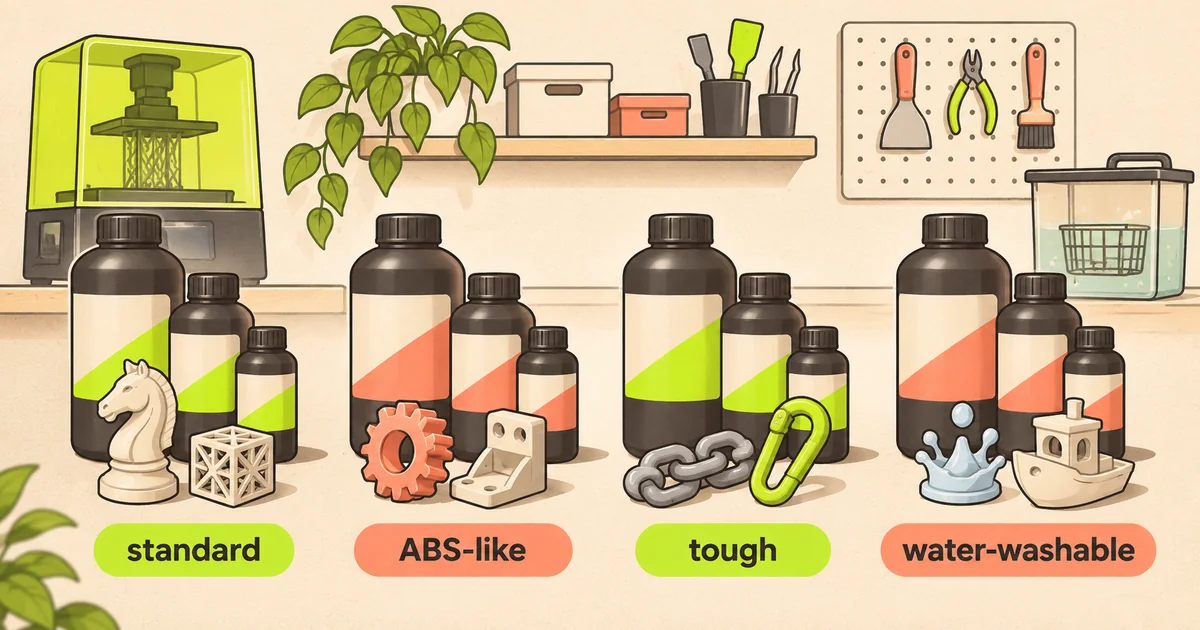
“Standard water-washable” generally signals a general modelling product, but the name is not a standardised test class. “ABS-like water-washable” is intended to communicate a balance closer to a tougher thermoplastic, yet it does not turn the photopolymer into ABS. “Tough”, “flexible”, “castable” and “plant-based” are likewise product families, not guarantees shared across makers.
For display miniatures, prioritise a maintained profile, surface detail and dimensional consistency. For gaming miniatures, compare published tensile, elongation or impact data where test methods are stated, because thin weapons and ankles need resilience. For jigs or functional parts, check heat deflection, creep and long-term environmental limits. For jewellery casting, use a resin explicitly documented for the investment and burnout process rather than assuming any water-washable formula burns cleanly.
Do not use an ordinary hobby resin for food contact, dental, medical or prolonged skin-contact applications. Those uses need explicit certification and a validated process. A fully hard-looking model is not evidence of biocompatibility.
Colour and pigment matter
Exposure settings can vary by colour even within one resin family because pigment affects light penetration and scattering. Anycubic's resin-manual page publishes printer-and-resin starting profiles; use the row matching the model, resin and layer height. A profile for grey standard resin on one printer is not automatically correct for translucent water-washable resin on another.
Dark or highly pigmented resin may need a different normal-layer exposure. Translucent resin can show yellowing or internal cure differences. Begin with the maker's current profile, mix the bottle as directed without whipping in avoidable bubbles, control temperature within the stated range and run a small calibration piece.
Record layer height, normal exposure, bottom exposure, bottom layers, lift distances and speeds, rest times, resin temperature and batch. Change one variable at a time. A result called “overexposed” might also be light bleed, excessive anti-aliasing or a poorly cleaned calibration piece.
A practical shortlist method
- Download the exact SDS before ordering. Reject a listing that supplies only a marketing safety paragraph.
- Confirm the maker publishes a profile for your printer or at least the same light-engine class.
- Match the mechanical family to display, gaming, functional or casting use.
- Check available colours and whether the profile changes by colour.
- Read the wash instructions: water temperature, agitation, maximum soak and drying may differ.
- Read the post-cure wavelength, time and part-thickness notes.
- Confirm a local route for contaminated water and failed liquid resin.
The “best” bottle can therefore be different for two owners of the same printer. A painter making brittle display busts may value crisp surface and easy sanding. A tabletop player values resistance to drops and thin-part flex. A prototype maker values dimensions and temperature. The label “water-washable” answers none of those questions.
Plant-based is not a safety category
Elegoo's material-safety hub lists separate sheets for water-washable, plant-based, ABS-like and tough resin families. The existence of separate sheets is the clue: read each formula's hazards. A plant-derived ingredient does not erase reactive acrylates or make liquid suitable for drains. Environmental claims should be tied to a defined test or composition statement, not the colour of a leaf on the bottle.
Similarly, a low odour is not a low exposure reading. Smell thresholds and hazard thresholds are different concepts. Control skin and eye contact and airborne exposure based on the SDS and risk assessment, not whether someone in the room notices an odour.
Cost the complete process
Compare bottle size and current price using the resin cost helper, but add more than resin. Include closed wash containers, absorbent liners, compatible gloves, waste containers, filters used as directed, post-cure equipment and failed prints. Water may be cheaper than IPA at the point of use, yet contaminated-water storage and disposal still have a cost.
Avoid buying a large stock before validating one bottle on your printer. Resin has storage conditions and shelf information on its label. Keep it in the original closed container, away from light and outside living or food areas, at the maker's stated temperature.
Sources
- Elegoo material safety data hub — maker safety library, accessed 15 November 2026.
- Elegoo Water Washable Photopolymer Resin SDS — safety data sheet, accessed 15 November 2026.
- Anycubic resin manuals and settings — maker profiles, accessed 15 November 2026.
- HSE COSHH questions on safety data sheets — official guidance, accessed 15 November 2026.
Check current Amazon UK listings
These neutral links are places to check current availability, not extra recommendations. Confirm the exact model, size, colour, compatibility and current price on the listing. Product titles were checked 15 November 2026; sale prices change.
- ANYCUBIC Water Washable 3D Printer Resin 2.0 with Easy Post-Processing, High Precision and High Resilience, Low Odor and Anti-Yellowing 3D Resin for LCD/DLP Printers(Grey,1kg)
- ANYCUBIC Water Washable 3D Printer Resin 2.0 with Easy Post-Processing, High Precision and High Resilience, Low Odor and Anti-Yellowing 3D Resin for LCD/DLP Printers(Clear,1kg)
- ANYCUBIC Water Washable 2.0 3D Printer Resin(Grey, 2000g)
- ELEGOO 3KG Standard 3D Printer Resin Grey+Black+Translucent,Fast Curing
Read next
Compare IPA-cleaned and water-washable resin by fire risk, chemical exposure, drying, waste handling and maker instructions—not by the word washable.
Safety and workspaceResin printing safety and ventilation in a UK homePlan a separate, contained resin workspace around the exact SDS, source control, outdoor exhaust, skin and eye protection, spill response and local waste routes.