Guides · Safety and workspace
Resin printing safety and ventilation in a UK home
Plan a separate, contained resin workspace around the exact SDS, source control, outdoor exhaust, skin and eye protection, spill response and local waste routes.
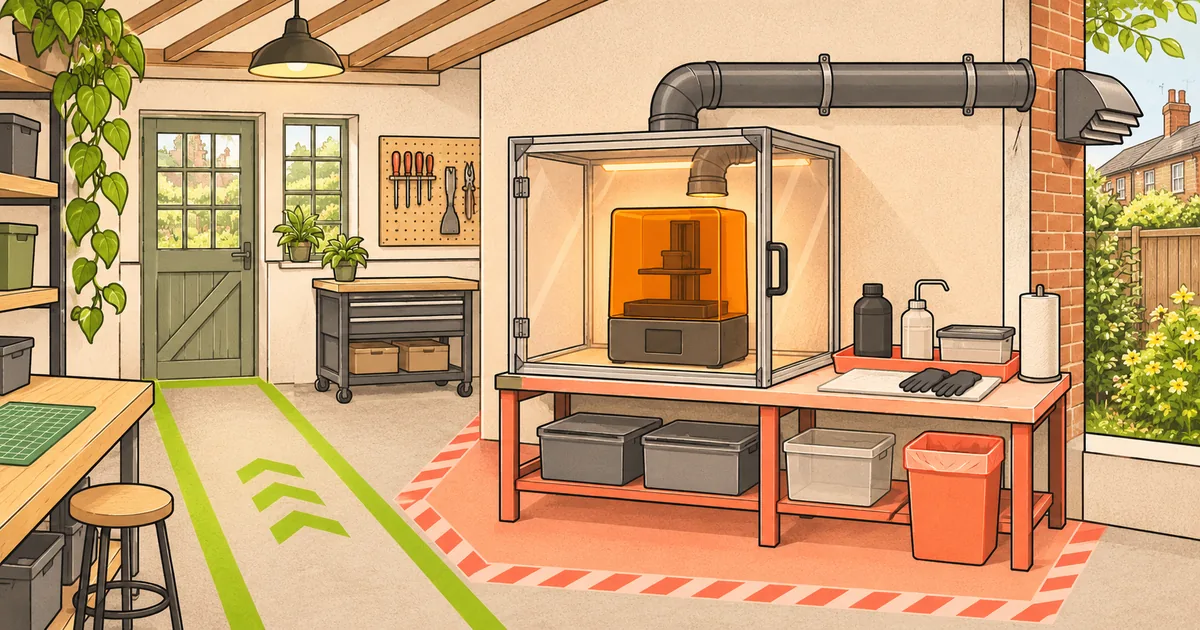
Resin printing should be treated as a chemical process, not as a normal desktop appliance. The printer, open vat, bottle transfer, dripping build plate, washing, support removal and waste all create opportunities for uncured photopolymer to reach skin, eyes, surfaces or air. A sensible home setup separates that process from routine living.
Workplace COSHH rules do not turn this page into a home legal assessment, but HSE's hierarchy is a strong practical framework: understand the substance, prevent exposure where possible, contain the process, use designed extraction and then select PPE. The exact resin and cleaning-liquid safety data sheets remain the starting documents.
Read the SDS before choosing the room
HSE says an SDS describes hazardous properties, possible health effects, routes into the body and measures for controlling exposure. Elegoo's water-washable photopolymer SDS, for example, classifies that mixture as causing skin irritation and serious eye damage and as capable of an allergic skin reaction. It instructs good ventilation or extraction and prevention of aerosols.
That is one product, not a substitute for your bottle's document. Download the current sheet before purchase, keep it accessible, and review it again if the formula, colour, cleaner or process changes. Read first aid, firefighting, accidental release, handling, storage, exposure controls and disposal—not only the hazard pictograms.
Skin sensitisation deserves particular attention. Repeated contact can lead to an allergic response, after which smaller exposures may provoke symptoms. Prevent contact from the first bottle rather than waiting for irritation. HSE's skin guidance prioritises control at source and enclosing the process where possible.
Choose a separate space
A kitchen, dining room, bedroom or shared living room mixes chemicals with food, sleep and uncontrolled occupants. Prefer a dedicated workshop or room that can be secured from children and pets, cleaned without soft furnishings, and ventilated without sending exhaust towards neighbours, doors or opening windows.
The room needs enough space to move a build plate from printer to drip position and wash container without crossing a clean route. Provide a continuous lipped work surface, closed chemical storage, stable waste containers and good lighting for drips. Avoid carpet and porous unfinished wood. Keep coats, laundry and household tools outside.
Cold garages introduce another problem: resin viscosity and maker temperature ranges. Do not solve it with an improvised heater beside IPA. Use equipment and heating methods approved by the printer and resin maker, keep ignition sources controlled and monitor the room conditions.
Enclosure and local exhaust
HSE describes enclosure and properly designed local exhaust ventilation as ways to minimise escape and capture vapour at a hood or booth. A resin-printer enclosure can therefore help only when it is reasonably sealed, has a controlled airflow path and exhausts to a safe place. A tent with no extraction is storage volume, not ventilation.
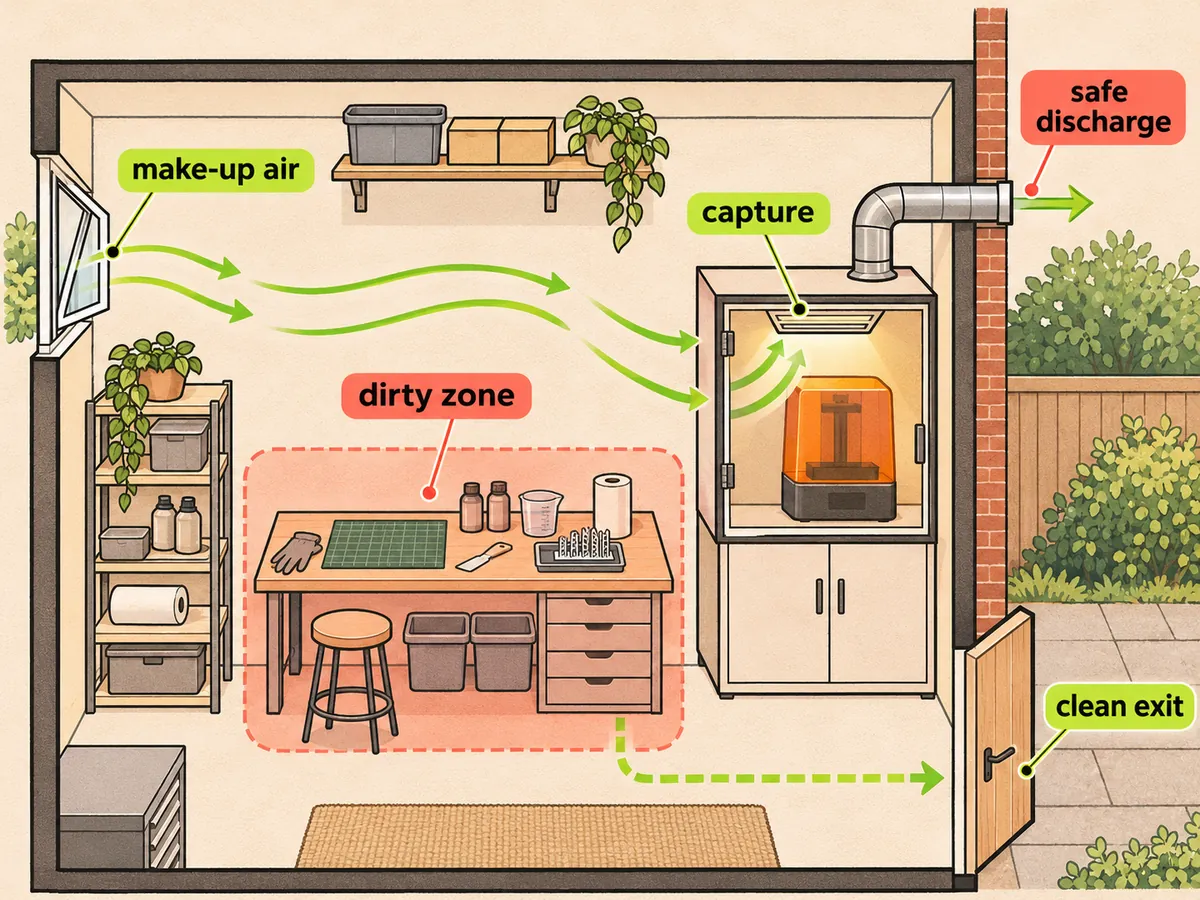
Air needs a route into the enclosure as well as out. Excess openings and frequent door lifting can defeat capture. Duct length, bends, fan position and discharge resistance affect flow. A fan's free-air rating is not the airflow through the installed system. If the risk cannot be controlled confidently, seek competent ventilation advice.
Exhaust outdoors where the discharge cannot return through windows or expose other people. Building alterations, electrical work and landlord conditions can apply; use a qualified electrician where mains wiring or a fixed fan requires it, and check local building requirements. This is not a design specification for a ventilation system.
What a carbon filter can and cannot do
Small activated-carbon units can reduce some odours in a covered printer. Odour reduction is not proof that all hazardous vapours are controlled, that the carbon remains effective or that the room has adequate air change. Carbon capacity depends on contaminant, concentration, humidity, contact time and replacement condition.
Use a printer carbon unit as one layer in the maker's system, not as the sole risk assessment. Keep a replacement schedule and do not use smell as the exhaustion indicator. An enclosure exhausted outdoors controls at source more clearly than recirculating room air through an unspecified filter.
Washing is often the higher-handling stage
Removing the build plate, scraping a wet part, cutting supports and moving wash liquid involve more open handling than the closed printing period. Place wash and drip stations inside the controlled zone, ideally under the same effective source control. Keep containers closed except during transfer.
IPA adds a flammable-liquid hazard. Keep it away from flames, sparks, heaters and equipment not rated for its vapour. Do not heat it or place it in a domestic ultrasonic cleaner. Water-washable resin removes IPA from the primary wash only if the maker says water is compatible; the resulting water remains contaminated.
For a detailed bench workflow, Resin Wash Bench covers closely related washing and workspace planning; the site returned HTTP 200 when checked 15 November 2026.
PPE and clean-hand discipline
Select gloves using the SDS and glove maker's compatibility information. Nitrile is commonly specified, but thickness, fit and chemical mixture matter. Wear chemical splash eye protection appropriate to the task. Dedicated clothing or an apron reduces transfer to ordinary clothes.
Divide the workflow into dirty and clean controls. Printer handles, wash lids and tools may be contaminated; door handles, phones, notebooks and keyboards should remain clean. Change gloves before touching them. Store clean gloves where a contaminated hand does not reach across the box.
Respiratory protective equipment is not a casual replacement for ventilation. Correct selection can require contaminant data, fit testing, facial-hair control, filters and a change schedule. If the SDS or assessment points to respirator use, obtain competent advice and prioritise engineered source control.
Spills and waste
Prepare the spill method before pouring. Keep the SDS-named absorbent and compatible waste container nearby. Isolate power where safe, prevent spread, protect skin and eyes, and avoid wiping contamination across a larger area. Resin beneath the vat or inside electronics requires the printer maker's service procedure.
Formlabs' disposal guidance says liquid or partly cured resin and contaminated IPA should not enter drains or household waste. Keep contaminated water under the same principle. Contact your council or hazardous-waste service for the local household route; businesses must meet their waste duties. Store waste sealed, labelled, upright and in secondary containment while awaiting disposal.
A pre-print room check
- Current SDS and manual accessible.
- Children, pets, food and soft furnishings excluded.
- Extraction operating with a clear make-up-air path and safe discharge.
- Gloves, goggles and protective clothing ready in the correct sizes.
- Drip tray, wash containers and waste containers closed and labelled.
- No flame, spark or unsuitable heater near IPA.
- Clean exit route and handwashing plan established.
- Vat film inspected and no cured debris in the resin.
If the room cannot meet those basics, pause the print and redesign the process. A successful model is not worth an uncontrolled chemical exposure.
Sources
- HSE COSHH overview — official guidance, accessed 15 November 2026.
- HSE COSHH risk assessment — official guidance, accessed 15 November 2026.
- HSE COSHH questions and SDS guidance — official guidance, accessed 15 November 2026.
- HSE managing skin exposure — official guidance, accessed 15 November 2026.
- Elegoo Water Washable Photopolymer Resin SDS — safety data sheet, accessed 15 November 2026.
Read next
Compare IPA-cleaned and water-washable resin by fire risk, chemical exposure, drying, waste handling and maker instructions—not by the word washable.
Safety and workspaceBest nitrile gloves and safety kit for resin printingBuild a resin-printing safety kit around the current SDS: suitable nitrile gloves, chemical splash eye protection, containment, tools and labelled waste—not a generic bundle.