Guides · Resins and materials
IPA vs water-washable resin: two cleaning systems compared
Compare IPA-cleaned and water-washable resin by fire risk, chemical exposure, drying, waste handling and maker instructions—not by the word washable.
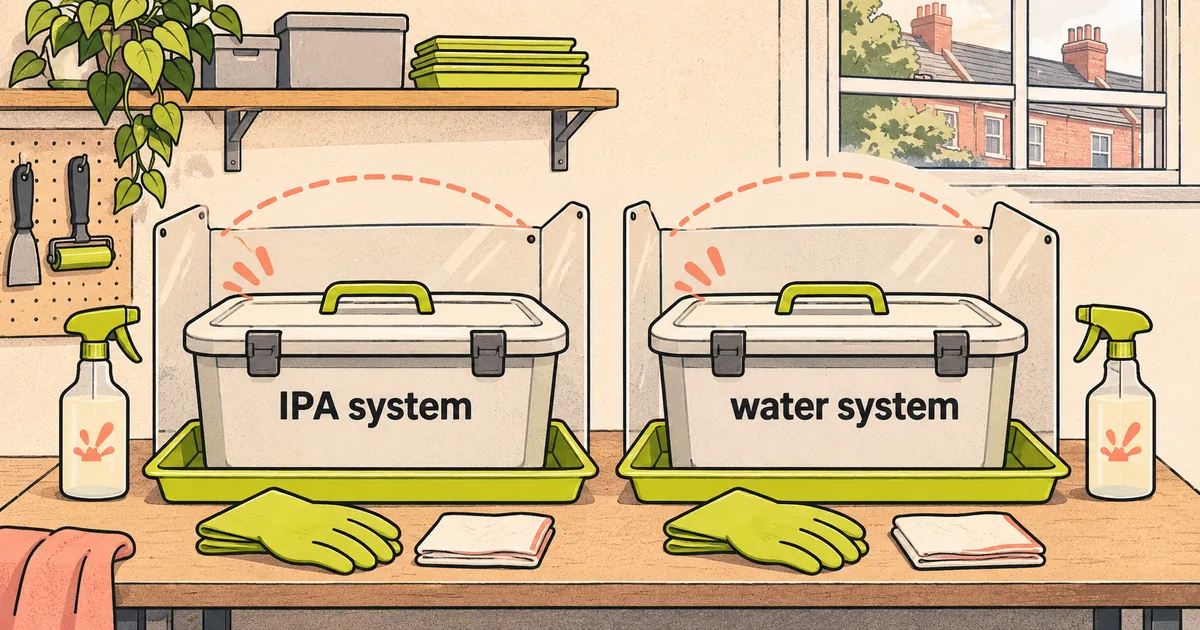
We haven't tested these products. This comparison is based on makers' published specifications and manuals, retailer listings and owner reviews (checked 15 November 2026).
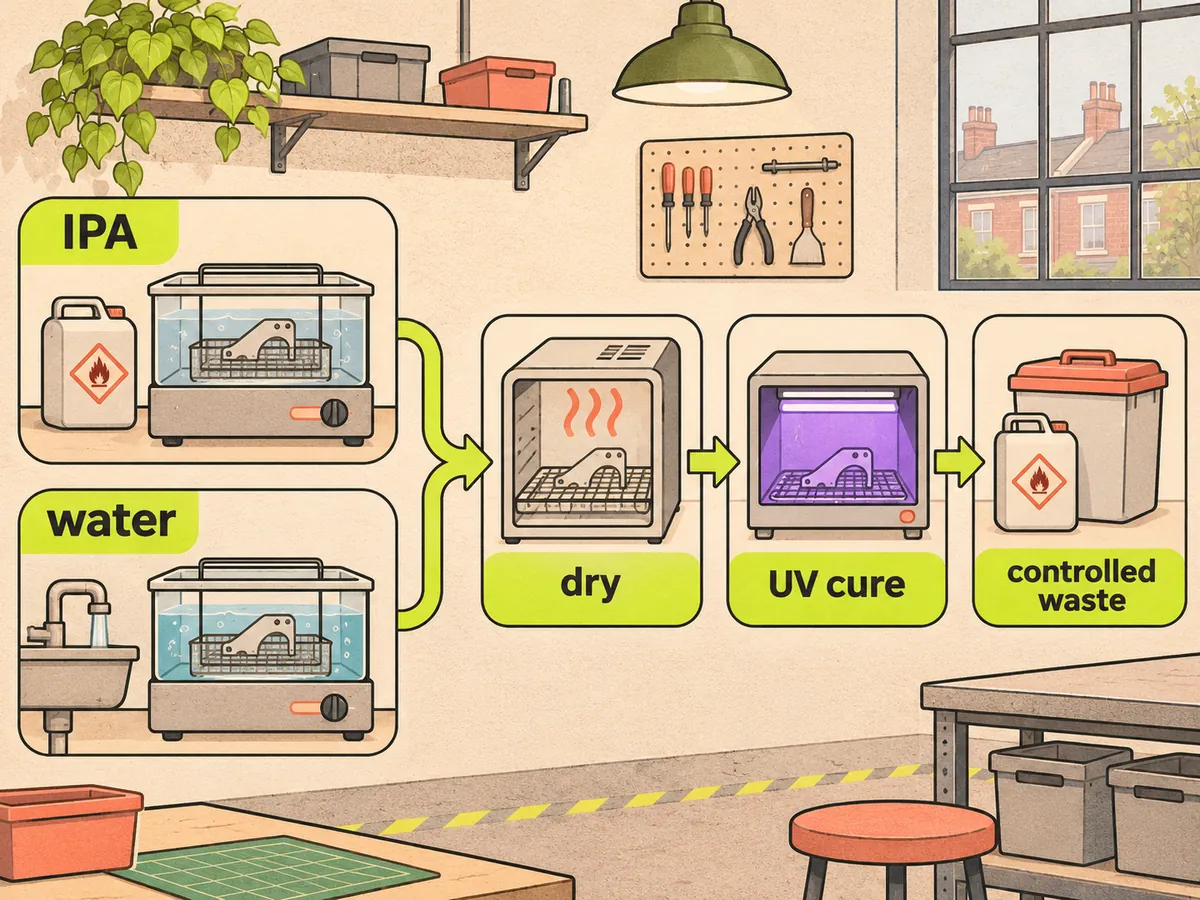
IPA-cleaned resin and water-washable resin move one hazard in different directions. An IPA workflow adds a volatile, flammable cleaning liquid. A water-washable workflow avoids IPA for the main wash where the maker permits, but creates contaminated water that still contains uncured photopolymer. Neither system belongs in a sink, and neither makes uncured resin safe to touch.
Choose after reading both documents: the resin's safety data sheet and, for an IPA process, the solvent's own SDS. Then plan containment, ventilation, storage and a local waste route. A product name is not a risk assessment.
The core comparison
| Question | IPA-cleaned resin | Water-washable resin |
|---|---|---|
| Main wash liquid | IPA at the concentration and method the resin maker specifies | Water, if the exact resin instructions say so |
| Added physical hazard | Flammable solvent and vapour | No IPA fire load in the main wash |
| Resin contact hazard | Present | Present |
| Drain disposal | No contaminated IPA | No contaminated water |
| Drying | IPA is volatile; control vapour and ignition | Water can remain in cavities longer |
| Post-cure | Required to maker guidance | Required to maker guidance |
The table does not declare a winner because the room and the output matter. A detached, ventilated workshop with proper flammable-liquid storage poses different constraints from a small spare room. A print with deep internal channels poses different drying problems from a solid miniature.
What IPA does well
IPA is a commonly specified cleaning solvent for many hobby photopolymers. In a closed agitation container it can remove liquid resin from detail and then evaporate from an open, well-controlled drying stage. It is compatible only when the resin and equipment maker say it is; do not assume every solvent or concentration suits every formula or wash station.
A two-stage arrangement can make the process more efficient. The first closed bath removes most resin. A cleaner second bath finishes the surface. Let sediment settle only according to a controlled procedure and do not pour or filter contaminated liquid into a drain. A filter transfers contamination to the filter; it does not make the liquid automatically safe.
The disadvantage is the additional fire and vapour risk. Keep IPA in its original or suitable labelled closed container, away from flames, heaters, sparks and incompatible materials. Do not heat it or place it in an ultrasonic cleaner unless the equipment is explicitly designed and rated for that solvent and the maker's instructions permit the process. A domestic appliance is not a hazardous-liquid control system.
What water-washable changes
Water-washable resin can be cleaned with water under the product instructions. That may simplify purchasing and remove the flammable solvent from the primary wash. It can also be attractive where an owner cannot safely store a useful volume of IPA.
The cleaning water becomes chemical waste. Elegoo's water-washable resin SDS lists skin irritation, allergic skin reaction and serious eye damage hazards, and instructs good ventilation or extraction. These classifications apply to the resin mixture even though water removes it from the model. Gloves, eye protection, containment and controlled waste remain part of the process.
Water can lodge in hollow models and small channels. Provide two openings where geometry permits so liquid can move through rather than form an airlock. Drain, rinse only by the maker's method and dry fully before UV cure. Sealing contaminated water or uncured resin inside a model can lead to cracking or leakage later.
Disposal is a local question
Formlabs says not to pour liquid or partly cured resin into drains or household waste and not to pour IPA or other solvent containing dissolved resin into drains or household waste. Its page also says appropriate disposal methods vary by location. That is the responsible level of generality for a UK-wide guide.
Keep spent IPA or wash water sealed, upright and labelled. Ask your local council's household hazardous-waste service or recycling centre about resin-contaminated liquid before travelling; acceptance and booking rules differ. Businesses have separate waste duties and should use an authorised route. Do not leave open trays outside to evaporate, where children, animals, rain and ignition sources cannot be controlled.
Solid drips, wipes and failed prints also need attention. “Cure before disposal” is often useful maker guidance, but cure must reach all contaminated material and the local authority decides the accepted bin or waste stream. A bag of liquid-filled supports is not cured waste merely because its outside saw sunlight.
Ventilation is not decided by smell
HSE's COSHH assessment guidance says to consider how a substance can be breathed, contact or pass through skin, or be swallowed, plus frequency, duration and who else may be exposed. It advises preventing exposure first and using enclosure or local exhaust ventilation where appropriate. Although COSHH is workplace law, its hierarchy is a useful way for a home user to think clearly.
An enclosure can contain a source only if air goes somewhere controlled. A printer cover or small carbon unit is not automatically a room ventilation solution. Venting outdoors requires a safe discharge location and a designed airflow path; opening a window without knowing flow direction is less controlled. Keep the printing and washing zone away from occupied rooms and food preparation.
Low odour is not proof of low concentration or low hazard. Nose fatigue and individual sensitivity make smell a poor instrument. Use the SDS and process controls.
Surface failures and diagnosis
A sticky model after IPA washing may indicate a saturated bath, insufficient agitation, an incompatible cleaning process, poor drying or under-cure. A chalky or cracked surface can follow excessive soak, trapped liquid, aggressive cleaning or incompatible cure. With water-washable resin, white residue may indicate retained water or incomplete cleaning, but appearance alone cannot identify the cause.
Change one part of the workflow at a time. Use a dirty and clean bath, record wash duration, dry in a repeatable position and follow a documented post-cure. Inspect hollow parts at openings. Do not add exposure or cure time reflexively when the actual problem is contaminated wash liquid.
Which should you choose?
Choose an IPA-cleaned resin when its mechanical or surface properties suit the part, the maker provides a profile, and you can control flammable-liquid storage, vapour, washing and disposal. Choose water-washable when its properties suit the part and removing IPA from the primary wash materially improves your controlled setup—while accepting contaminated-water storage and drying.
Do not choose either because a label sounds ecological. Compare the exact SDS, mechanical data, printer profile and waste route. The water-washable buying guide covers product selection; the safety guide covers the room.
Sources
- Elegoo Water Washable Photopolymer Resin SDS — safety data sheet, accessed 15 November 2026.
- Formlabs disposal guidance — maker guidance, accessed 15 November 2026.
- HSE: how to carry out a COSHH risk assessment — official guidance, accessed 15 November 2026.
- HSE COSHH questions — official guidance, accessed 15 November 2026.
Read next
Water-washable resin can simplify the cleaning liquid, but it remains uncured photopolymer. Compare safety data, mechanical intent, colour and maker profiles before buying.
Printing and post-processingWashing and curing resin prints without losing control of wasteA step-by-step post-processing workflow for draining, two-stage washing, support removal, drying, UV post-cure and segregating contaminated liquids and solids.