Guides · Choosing a printer
Best resin printers UK: a specification-led shortlist
Compare the Elegoo Mars 5 Ultra, Saturn 4 Ultra 16K, Anycubic Photon Mono M7 Pro, Phrozen Sonic Mini 8K S and Creality HALOT-MAGE S by published build area, pixel size and workflow.
This page contains Amazon affiliate links. As an Amazon Associate we earn from qualifying purchases. Prices and availability can change; check the exact listing before buying.
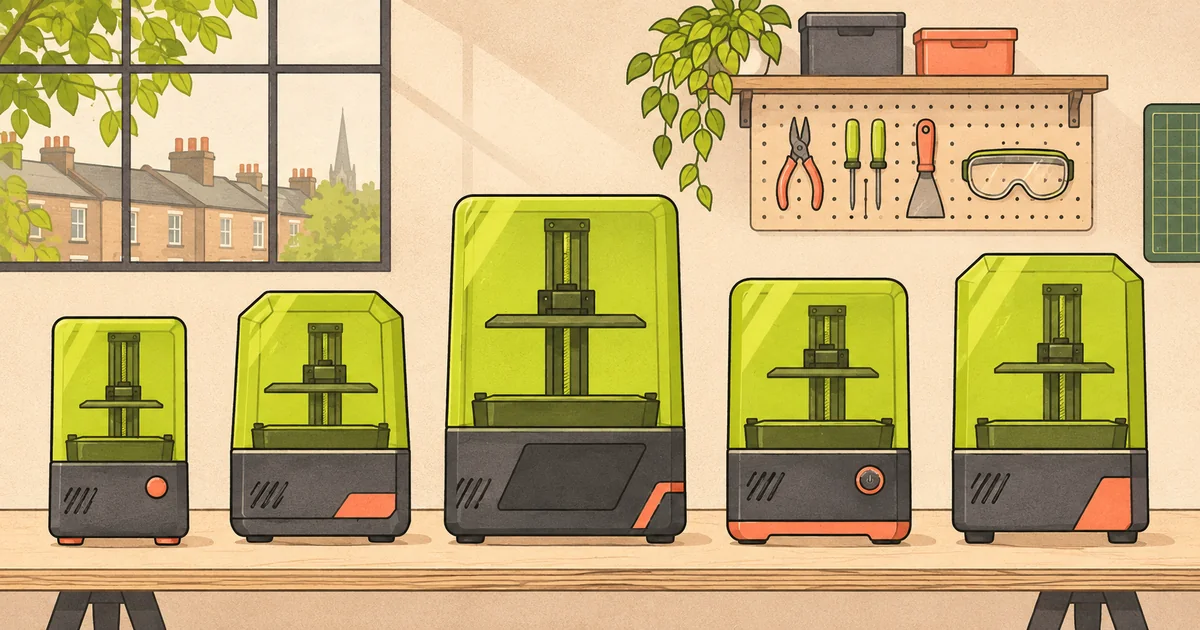
We haven't tested these products. This comparison is based on makers' published specifications and manuals, retailer listings and owner reviews (checked 15 November 2026).
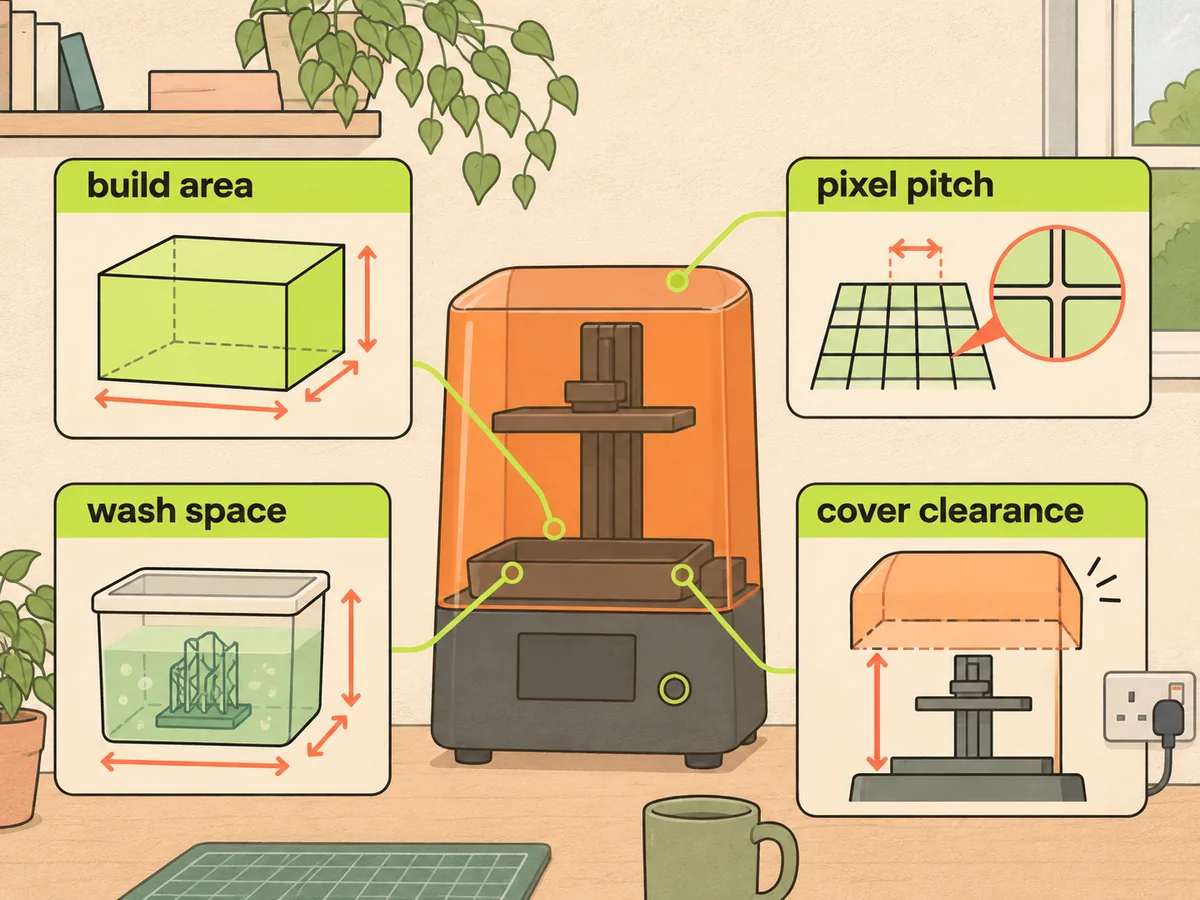
There is no single best resin printer. A useful shortlist starts with the largest object you genuinely plan to make, the detail scale you can perceive, and the washing and curing capacity you can accommodate. A larger screen can expose more parts per layer, but it also creates a bigger vat to handle and a larger build plate to clean. A headline such as “14K” describes the LCD pixel count, not the whole print system.
This shortlist uses current maker pages opened on 15 November 2026. It avoids prices because a reliable sterling price could not be confirmed consistently across official UK pages. Check the maker and a UK retailer before buying, and budget for resin, replacement release film, screen protection, wash liquid, gloves, eye protection and post-curing—not only the printer.
Shortlist at a glance
| Printer | Maker-published build volume | Published screen or XY detail | Best fit on paper |
|---|---|---|---|
| Elegoo Mars 5 Ultra | 153.36 × 77.76 × 165 mm | 7-inch 9K; 18 × 18 μm XY | Compact batches and small models |
| Phrozen Sonic Mini 8K S | 165 × 72 × 170 mm | 22 μm XY | Miniatures on a compact plate |
| Elegoo Saturn 4 Ultra 16K | 211.68 × 118.37 × 220 mm | 16K mono LCD | Larger batches and taller pieces |
| Anycubic Photon Mono M7 Pro | about 223 × 126 × 230 mm | 10.1-inch 14K; 16.8 × 24.8 μm | Integrated heating and refill features |
| Creality HALOT-MAGE S | 223 × 126 × 230 mm | 10.1-inch 14K; 16.8 × 24.8 μm | Large plate with network transfer |
The figures are not directly interchangeable. Pixel pitch describes projected pixel dimensions on the build plane; screen resolution alone does not. Z movement, light uniformity, resin behaviour, exposure, anti-aliasing, model preparation and post-processing also affect the result. Treat maker speed claims as best-case settings tied to a resin, layer height and motion profile, not the duration of your next model.
Best compact all-round option: Elegoo Mars 5 Ultra
Elegoo publishes a 153.36 × 77.76 × 165 mm build volume, 18 × 18 μm XY resolution, 0.01–0.2 mm layer range and a 7-inch 9K monochrome LCD. The maker also lists tilt release, automatic levelling, residue and resin-shortage detection, Wi-Fi and power-loss resume. Those features reduce some setup chores, but none removes the need to inspect the vat and screen area before every job.
The Mars size is sensible if most work is tabletop figures, small prototypes or jewellery masters and if bench depth is limited. Its narrower plate can be easier to drain and wash than a 10-inch class plate. The trade-off is batch area: arranging a whole army or a wide terrain part may require more runs. Confirm that your chosen wash station accepts either the complete build plate or the largest model after removal.
Best compact miniature specialist: Phrozen Sonic Mini 8K S
Phrozen lists a 165 × 72 × 170 mm print volume, 22 μm XY resolution, 0.01–0.30 mm layers and a 50 W system. The maker's support centre specifies FEP film and CHITUBOX 1.9.0 or later. It is a straightforward specification: a narrow plate, fine published pixel pitch and front USB transfer.
This is the least feature-heavy selection here, which can be a virtue if you prefer a simple local workflow. It also means there is no reason to pay for it on a screen-resolution number alone. Compare replacement LCD and film availability in Britain, the warranty terms for the LCD, and current slicer profiles. Phrozen's support page lists the mono LCD warranty separately from the main body, so read those terms before purchase.
Best medium-format Elegoo option: Saturn 4 Ultra 16K
Elegoo's announcement gives a 211.68 × 118.37 × 220 mm build volume and up to 150 mm/h. It also describes a tank heater intended to hold resin at 30°C and the maker's tilt-release system. The useful buying fact is the footprint class: the plate offers materially more batch area than a Mars while remaining below the very largest desktop machines.
Heating can help make a cold-room process more repeatable, but 30°C is the maker's equipment description, not a universal resin target. Follow the temperature range on the bottle or technical data sheet. If a heater, camera or network feature matters to you, confirm whether it is built in, region-dependent or accessory-dependent on the exact version sold.
Best integrated workflow features: Anycubic Photon Mono M7 Pro
Anycubic publishes about 223 × 126 × 230 mm of build volume, a 10.1-inch 14K monochrome LCD and 16.8 × 24.8 μm XY pixel dimensions. Its page lists a temperature-controlled vat, automatic resin refill, residue detection, release-film life reminder and USB, Wi-Fi and LAN transfer. The published layer range is 0.01–0.15 mm.
Those features are most relevant to a user printing frequently enough to maintain them. Auto-fill creates another resin path to clean; heating adds power and control hardware; network transfer adds firmware and account questions. Read the manual, decide whether you will use each feature, and check that spare parts are obtainable. A simpler printer with a disciplined workflow may suit occasional printing better.
Best large-plate alternative: Creality HALOT-MAGE S
Creality publishes a 223 × 126 × 230 mm build volume, 10.1-inch 14K LCD, 16.8 × 24.8 μm pixel dimensions and 0.05–0.2 mm layer range. Its comparison page lists USB, Ethernet, Wi-Fi and Creality Cloud transfer, plus HALOT BOX, CHITUBOX and Tango compatibility. The machine dimensions are given as 333 × 270 × 608 mm.
That 608 mm height is a reminder to measure vertically, including room to open or remove a cover. Network features should not decide the purchase unless the local workflow works when the service is unavailable. Confirm the exact slicer and firmware support for the model you buy, rather than assuming every HALOT profile is interchangeable.
What to measure before ordering
Measure the bench, door route and overhead clearance. Add a contained “dirty” zone beside the machine, a closed wash container, a cure station, drip space and labelled waste storage. Resin printing in a living room, kitchen or bedroom is a poor starting plan because uncured resin and contaminated solvent must be controlled away from food, children, pets and routine occupancy. Read the workspace safety guide before choosing a location.
Then download the current manual and locate the release-film replacement method, LCD replacement path, spare vat price, file format and supported slicer. A printer is a consumable system. Film, LCD protectors and eventually the LCD itself may need replacement; “mono” is not a promise of an indefinite screen life. Makers' warranty exclusions are more useful than an unsourced lifespan estimate.
Finally, choose by the complete workflow. For miniatures, the miniature-specific comparison explains why support strategy can matter more than another resolution label. Use the cost helper with your own bottle and slicer figures.
Sources
- Elegoo Mars 5 Ultra specifications — maker page, accessed 15 November 2026.
- Elegoo Saturn 4 Ultra 16K announcement — maker page, accessed 15 November 2026.
- Anycubic Photon Mono M7 Pro — maker page, accessed 15 November 2026.
- Phrozen Sonic Mini 8K S support page — maker support page, accessed 15 November 2026.
- Creality HALOT-MAGE S specification comparison — maker page, accessed 15 November 2026.
Check current Amazon UK listings
These neutral links are places to check current availability, not extra recommendations. Confirm the exact model, size, colour, compatibility and current price on the listing. Product titles were checked 15 November 2026; sale prices change.
Read next
A specification-led comparison for tabletop miniatures, focusing on pixel pitch, build area, release system, supports and the complete wash-and-cure workflow.
Choosing a printerHow MSLA resin printers work—and how to choose oneFollow one layer from sliced pixels through a monochrome LCD and release film, then translate screen, build-volume and motion specifications into a sensible buying decision.