Guides · Choosing a printer
Best resin printer for miniatures: what the numbers really mean
A specification-led comparison for tabletop miniatures, focusing on pixel pitch, build area, release system, supports and the complete wash-and-cure workflow.
This page contains Amazon affiliate links. As an Amazon Associate we earn from qualifying purchases. Prices and availability can change; check the exact listing before buying.
We haven't tested these products. This comparison is based on makers' published specifications and manuals, retailer listings and owner reviews (checked 15 November 2026).
For tabletop miniatures, the most useful printer is often the one that gives a repeatable workflow at the scale and batch size you actually use. Fine published XY pixel dimensions help, but support contact placement, model orientation, exposure, resin, cleaning and post-curing can erase or preserve more visible detail than a marketing resolution label.
Our compact shortlist is the Elegoo Mars 5 Ultra and Phrozen Sonic Mini 8K S. For larger batches, compare the Elegoo Saturn 4 Ultra 16K, Anycubic Photon Mono M7 Pro and Creality HALOT-MAGE S in the broader UK shortlist. The maker pages were checked on 15 November 2026; availability and bundles change, so verify the exact version and manual before paying.
The compact choices
Elegoo publishes an 18 × 18 μm XY figure and 153.36 × 77.76 × 165 mm build volume for the Mars 5 Ultra. Phrozen publishes 22 μm XY and 165 × 72 × 170 mm for the Sonic Mini 8K S. Both are compact-class machines. The Elegoo page describes automatic levelling, tilt release and several sensors; the Phrozen support page describes a simpler FEP-based machine with USB transfer.
On paper, 18 μm is smaller than 22 μm. That does not mean every edge will be visibly better. A printed contour crosses a pixel grid; exposure spreads light; anti-aliasing changes edge treatment; the model mesh has its own resolution; and paint covers the final surface. If your goal is gaming miniatures viewed at arm's length, consistency and support scars can be more important than the smallest number in the table.
The Mars plate is slightly wider while the Sonic Mini plate is slightly longer in the published dimensions. Lay out representative bases in the slicer before buying. A rectangle quoted in millimetres is more useful than “small” or “medium”, because base diameter and weapon overhang determine real batch count.
When a larger plate earns its space
A 10-inch class machine can expose more miniatures per layer, so a well-filled plate can produce a larger batch in roughly the same layer sequence as one figure. That is not the same as “faster” for every job. A bigger plate takes more resin to establish a safe vat level, produces larger peel loads, is heavier to handle and may not fit a compact wash station.
Choose it for regular batches, large monsters, busts or terrain—not because 14K sounds larger than 9K. Creality publishes 16.8 × 24.8 μm pixels for the HALOT-MAGE S; Anycubic publishes the same dimensions for the M7 Pro. Their rectangular pixels also remind us that one “resolution” label can hide different X and Y pitch.
Model files set the ceiling
A printer cannot recover detail absent from the mesh. Inspect the licensed file at the intended scale and confirm whether the designer provides pre-supported and unsupported versions. Pre-supports are a starting point tied to somebody's printer, resin and settings. They are not a warranty that your combination will release cleanly.
CHITUBOX documents hollowing as a way to reduce material and drill holes as a route for resin to escape. For a small gaming miniature, hollowing may create more problems than it solves: trapped resin, thin walls and drain holes in visible areas. For a large solid monster or bust, hollowing with properly placed drain and vent holes can reduce volume and peel force. The geometry decides.
Orientation is a surface-quality decision
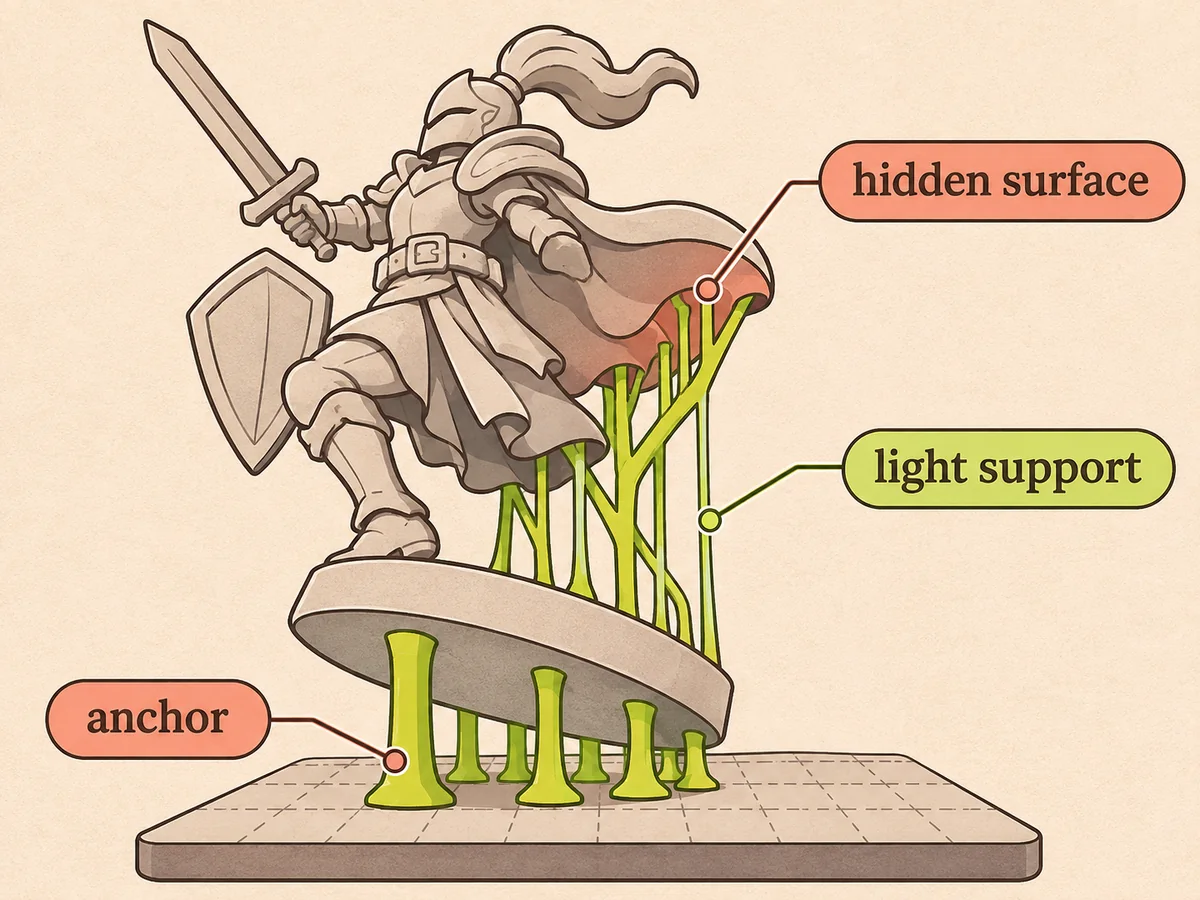
Printing a miniature perfectly upright can minimise support planning but can put every layer transition in similar places and create broad cross-sections on a base. Tilting can move contact points to hidden surfaces, stagger cross-sections and reduce a sudden area change. The best angle is not a universal 30°, 45° or other forum number. Inspect islands layer by layer and support loads back to the plate.
Place heavier supports where the earliest islands and major mass need restraint. Use lighter contacts for delicate tips only when the structure behind them is already stable. A forest of tiny supports can still fail if no strong path carries peel force. Conversely, oversized contacts can tear armour edges and faces. Read supports, orientation and hollowing for a systematic pass.
Resin choice changes the miniature
“Standard”, “ABS-like”, “tough” and “water-washable” are families, not controlled performance grades. For gaming pieces, look for the resin maker's impact or elongation data and cure schedule, then compare like-for-like test methods where available. A very stiff resin can preserve sharp edges but leave spears brittle; a tougher blend may survive handling while giving up something else in surface, cost or cleaning.
Water-washable does not mean skin-safe or drain-safe. Elegoo's water-washable SDS classifies the mixture for skin irritation, allergic skin reaction and serious eye damage. Whatever resin you choose, use the current SDS, prevent contact and collect contaminated wash liquid. The resin types guide separates convenience claims from hazard information.
Washing without losing detail
Overcrowding a wash basket can leave liquid resin in recesses. A two-stage wash—a dirtier first container and a cleaner finishing container—can prolong the useful clean stage and makes contamination visible. Use the cleaning liquid specified by the resin maker. If the resin is water-washable, the water becomes contaminated; it does not become suitable for a sink.
Let a model drain over the vat first. Avoid scrubbing fragile details with an uncontrolled splash. Wash hollow interiors through their openings, then ensure liquid can leave. Dry fully before curing; a glossy patch may be liquid resin, retained wash fluid or simply a surface difference, so do not use appearance alone as proof of safety.
Curing and support removal
Follow the resin maker's post-cure instructions rather than copying a time from a different colour or chemistry. Thin parts can overheat or distort in an aggressive cure. Thick parts may need rotation so light reaches recesses. An enclosed 405 nm station with a turntable improves repeatability, but wavelength and duration still need to match the resin.
Whether to remove supports before or after cure depends on the resin, geometry and maker guidance. Softer green parts can release supports more cleanly, but they are also uncured and must be handled inside the controlled zone with gloves and eye protection. Cutting a loaded support can flick contaminated material; use controlled tools and point parts away from your face.
A buying checklist for miniature makers
- Import three typical files and arrange their bases inside the published build rectangle.
- Check pixel dimensions, not only the “K” label.
- Download the manual and locate film, LCD and screen-protector replacement instructions.
- Confirm your slicer exports the exact file format and has a maintained profile.
- Measure the wash basket and cure chamber against the largest model and build plate.
- Price replacement film, a spare vat, resin, cleaning liquid and PPE.
- Plan a separate finishing and painting area. For the next stage, see Miniature Painting Stations—its home page returned HTTP 200 when checked 15 November 2026.
A miniature printer purchase is successful when the entire chain fits: file, slice, print, drain, wash, support removal, cure and paint. The printer is only one station in that chain.
Sources
- Elegoo Mars 5 Ultra specifications — maker page, accessed 15 November 2026.
- Phrozen Sonic Mini 8K S — maker support page, accessed 15 November 2026.
- Creality HALOT-MAGE S comparison — maker page, accessed 15 November 2026.
- CHITUBOX model editing documentation — software documentation, accessed 15 November 2026.
Check current Amazon UK listings
These neutral links are places to check current availability, not extra recommendations. Confirm the exact model, size, colour, compatibility and current price on the listing. Product titles were checked 15 November 2026; sale prices change.
Read next
Compare the Elegoo Mars 5 Ultra, Saturn 4 Ultra 16K, Anycubic Photon Mono M7 Pro, Phrozen Sonic Mini 8K S and Creality HALOT-MAGE S by published build area, pixel size and workflow.
Choosing a printerHow MSLA resin printers work—and how to choose oneFollow one layer from sliced pixels through a monochrome LCD and release film, then translate screen, build-volume and motion specifications into a sensible buying decision.
Printing and post-processingResin supports, orientation and hollowing: a layer-by-layer methodOrient resin models by cross-section and visible surfaces, support every island through a load path, and hollow only with drain and vent openings that work during print and wash.