Guides · Printing and post-processing
Best wash and cure stations: size the workflow, not the badge
Compare Elegoo Mercury Plus V3.0 and Anycubic Wash & Cure 3 Plus by published washing and curing capacity, then decide whether separate stations suit you better.
This page contains Amazon affiliate links. As an Amazon Associate we earn from qualifying purchases. Prices and availability can change; check the exact listing before buying.
We haven't tested these products. This comparison is based on makers' published specifications and manuals, retailer listings and owner reviews (checked 15 November 2026).
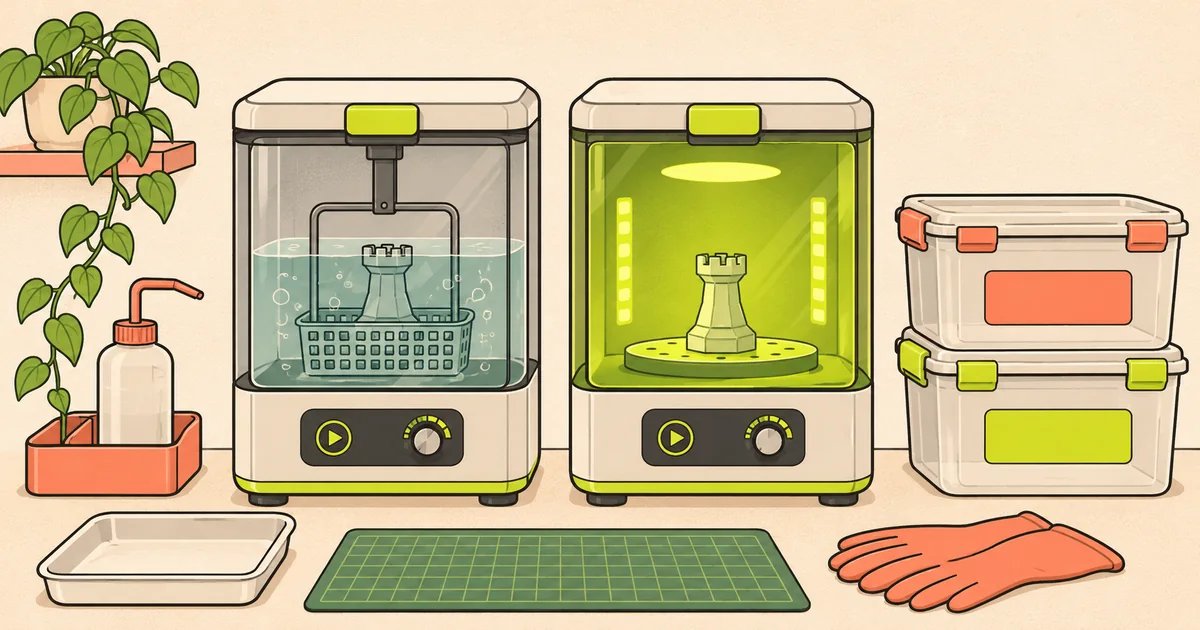
A wash and cure station earns its space by containing two repetitive jobs: agitating a compatible cleaning liquid around a printed part, then rotating the dry part under UV light. The “best” model is the one whose usable basket and cure envelope accept your actual prints, while leaving a safe route for dirty liquid and drips. Capacity claims are not interchangeable, so compare millimetres rather than litres alone.
The two maker-documented choices here are the Elegoo Mercury Plus V3.0 and Anycubic Wash & Cure 3 Plus. Both are intended for 405 nm-class resin workflows and both combine wash and cure modes. Neither makes contaminated liquid disposable, removes the need for gloves and eye protection, or decides the correct cure time for a resin.
Published dimensions
| Station | Maximum wash information | Curing information | Controls and light |
|---|---|---|---|
| Elegoo Mercury Plus V3.0 | Basket mode 230 × 135 × 260 mm; hanging mode 214 × 135 × 180 mm | Maker describes 360° turntable | 24 × 405 nm LEDs; up to 30 minutes |
| Anycubic Wash & Cure 3 Plus | 230 × 140 × 260 mm; 7.6 L basket on product page | Manual gives 210 mm diameter × 260 mm | 405 nm; 1–30 minutes on product page |
Anycubic's manual and store page differ on some secondary figures such as weight, which is why a current manual should be checked before purchase. The core dimensional figures above agree on the washing envelope. Do not infer that a nominal printer screen size guarantees build-plate compatibility; handles, brackets and plate shape matter.
Elegoo Mercury Plus V3.0
Elegoo publishes two washing modes. Basket mode takes a removed model up to 230 × 135 × 260 mm. Hanging mode supports a build plate on adjustable brackets, with a smaller published envelope of 214 × 135 × 180 mm. That distinction is useful: washing on the plate reduces handling while the print is most contaminated, but it can carry more resin into the bath and demands an exact mechanical fit.
The station uses 24 405 nm LEDs around a rotating curing arrangement, including a light beneath the transparent turntable according to the maker. Its cover and interlock are useful engineering controls, but the cover is not a licence to stare at active UV or bypass a switch. Follow the manual and keep the enclosure intact.
Choose it on paper if its bracket accepts your exact Elegoo or other plate and if the 135 mm basket width is enough for your models. For a large Saturn-class print that fills the plate, the part may need removal and a different container even if one plate dimension looks compatible.
Anycubic Wash & Cure 3 Plus
Anycubic publishes a maximum cleaning volume of 230 × 140 × 260 mm, a 7.6 L cleaning basket and a 12 L bucket. The product page specifies ten 405 nm LEDs plus a gooseneck light and a 1–30 minute setting range. Its manual gives a 210 mm diameter by 260 mm cure volume and 36 W rated power.
The gooseneck lamp is designed to direct additional light at a local area. That is a feature to use according to the manual, not evidence that more UV is always better. A small thin model can warm and distort; an opaque or complex model can shade itself. Rotate, inspect and use the resin maker's cure schedule.
The slightly wider published basket does not settle compatibility by itself. Check the bracket, plate handle and model height. If you use a different printer brand, assume nothing until the dimensions and support method are confirmed.
One combined station or two separate stations?
A combined station saves bench space but cannot normally wash and cure at the same time. Changing modes means removing or sealing the wash tub, cleaning any drips, fitting the turntable and ensuring the part is dry. For occasional prints, that is often acceptable. For repeated batches, separate wash and cure stations can keep liquid handling physically apart from final curing.
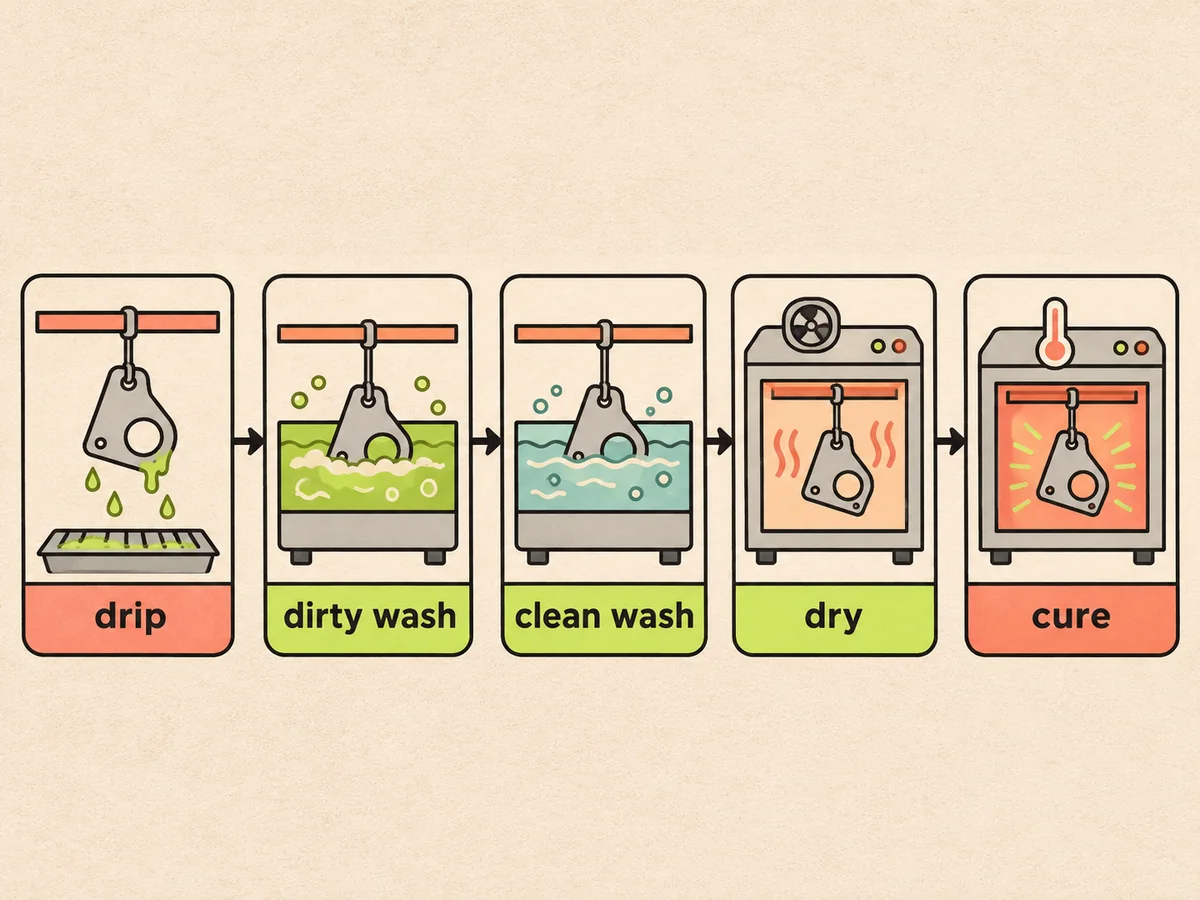
Separate equipment also lets you build a two-stage wash. The first closed container takes most liquid resin; the second, cleaner bath finishes the surface. A magnetic-agitation station can be one stage, not necessarily the whole process. Labels should identify the resin family and cleaning liquid, and lids should remain closed when not in use.
Manual washing can work with purpose-made sealed containers and compatible tools, but uncontrolled brushing or shaking can splash. An ultrasonic cleaner introduces separate manufacturer restrictions, solvent and fire questions; never place a flammable liquid into equipment that is not specifically designed and rated for it. This guide does not recommend improvised heated IPA cleaning.
Water does not remove the waste problem
If the resin is water-washable, the station may agitate water instead of IPA only where the station and resin instructions allow it. That water now contains uncured photopolymer. Elegoo's current water-washable SDS classifies that resin as causing skin irritation and serious eye damage and as capable of an allergic skin reaction. “Water-washable” describes the cleaning carrier, not safe disposal.
Formlabs' disposal guidance says not to pour liquid or partly cured resin, or solvent containing dissolved resin, into drains or household waste. Local routes vary. Keep spent liquid sealed and labelled, and ask your council or household waste site what it accepts. Do not assume sunlight through a cloudy container makes an unknown volume safe; follow the resin and local waste guidance.
Curing time comes from the resin
The station timer is only a timer. Pigment, part thickness, light geometry, resin chemistry and previous washing all affect the cure. Use the resin technical data or instructions for a starting duration and compatible wavelength. If the maker publishes a range, turn the part so shaded faces receive light and avoid piling models together.
A tacky surface after washing can indicate incomplete cleaning, oxygen inhibition, trapped wash liquid or inadequate cure. Repeatedly adding UV without diagnosing the cause can make a brittle outside while leaving contamination in a cavity. Hollow parts need drain and vent openings large enough to wash and dry internally.
Measure this before buying
- The largest model dimensions after supports, not only the printer's nominal build volume.
- The exact build plate width, depth, handle and bracket geometry if you want plate washing.
- The cure chamber's diameter and height after allowing for the turntable.
- Bench clearance to remove the cover and lift a full liquid bucket safely.
- A lidded storage position for the bucket, plus a route for spent liquid.
- Replacement bucket, rotor and turntable availability.
For a broader workspace layout, Resin Wash Bench overlaps strongly with washing, containment and ventilation; its home page returned HTTP 200 when checked 15 November 2026. Read our washing and curing guide before the first print.
Sources
- Elegoo Mercury Plus V3.0 — maker page, accessed 15 November 2026.
- Anycubic Wash & Cure 3 Plus — maker page, accessed 15 November 2026.
- Anycubic Wash & Cure 3 Plus manual — maker manual, accessed 15 November 2026.
- Formlabs cartridge and resin disposal guidance — maker safety guidance, accessed 15 November 2026.
Check current Amazon UK listings
These neutral links are places to check current availability, not extra recommendations. Confirm the exact model, size, colour, compatibility and current price on the listing. Product titles were checked 15 November 2026; sale prices change.
Read next
Compare IPA-cleaned and water-washable resin by fire risk, chemical exposure, drying, waste handling and maker instructions—not by the word washable.
Printing and post-processingWashing and curing resin prints without losing control of wasteA step-by-step post-processing workflow for draining, two-stage washing, support removal, drying, UV post-cure and segregating contaminated liquids and solids.
Printing and post-processingResin supports, orientation and hollowing: a layer-by-layer methodOrient resin models by cross-section and visible surfaces, support every island through a load path, and hollow only with drain and vent openings that work during print and wash.